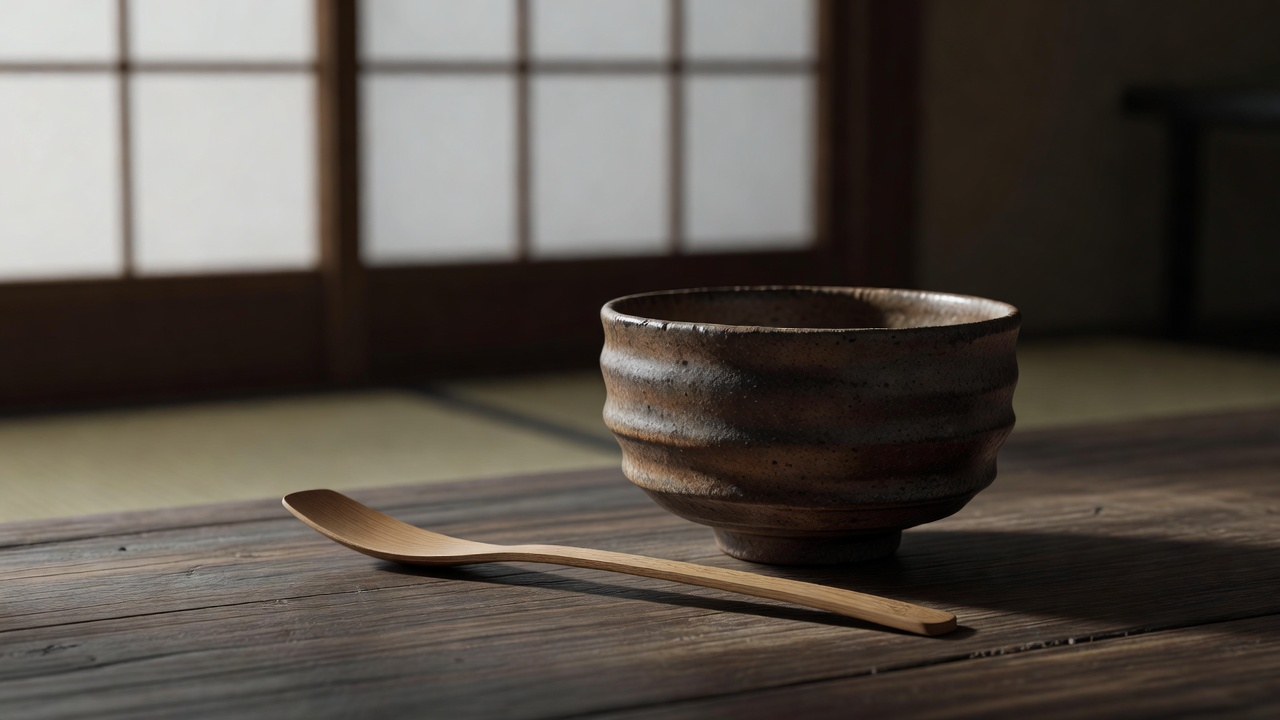
“Japanese tea ceremony” is a convenient English label for a field with substantial historical and living diversity. It can suggest a single fixed ceremony when there are many procedures, teaching communities and kinds of gathering. Chanoyu emphasizes hot water for tea in its literal wording; chadō and sadō express the way of tea. None of these terms should erase the differences among people who use them.
A lineage is not simply a style category such as rustic, formal or decorative. It involves transmission: teachers, inherited procedures, institutions, objects, texts and relationships through which practice continues. That continuity includes change. Contemporary teaching takes place in homes, schools, cultural organizations and international communities as well as in historically established settings.
A history with more than one beginning
Tea reached Japan through exchanges with the Asian mainland over a long period. Buddhist institutions were important to its transmission, but tea also circulated within courtly, commercial and warrior worlds. Eisai is often discussed in accounts of tea and medieval Japan; he should not be made the sole inventor of every practice that later developed around powdered tea.
Murata Jukō, Takeno Jōō and Sen Rikyū are central figures in histories of the development associated with wabi-cha. Their names point toward changing values in objects, rooms and hospitality rather than a simple moment when an entire tradition appeared fully formed. Sakai, Kyoto and the tea-producing region of Uji are useful places to keep in view when reading about these networks.
Rikyū’s relationships with the political worlds of Oda Nobunaga and Toyotomi Hideyoshi also complicate a purely tranquil picture of tea. A small room and an apparently modest bowl existed within societies shaped by status, wealth and power. History becomes more interesting when these tensions are retained instead of replacing them with a timeless story about serenity.
The three Sen-family traditions
Omotesenke, Urasenke and Mushakōjisenke are often grouped as the san-Senke, the three Sen houses. Their histories connect through Rikyū’s descendants and the household of Sen Sōtan. Three of Sōtan’s sons are associated with the continuing houses: Kōshin Sōsa with Omotesenke, Sensō Sōshitsu with Urasenke and Ichiō Sōshu with Mushakōjisenke.
Omotesenke
A Sen-family tradition associated with the Fushin’an tea room in Kyoto. Consult its own explanations for its history, principles and practice rather than reducing it to a visual feature of prepared tea.
Urasenke
A Sen-family tradition associated with Konnichian in Kyoto, with an extensive international teaching presence. Its publicly available English resources are a useful entry point, while remaining accounts from a particular lineage.
Mushakōjisenke
A Sen-family tradition associated with Kankyūan in Kyoto. It has its own inherited methods and institutional history; smaller visibility in English-language media does not make it a secondary version of another house.
These descriptions identify relationships, not rankings. The amount of foam on a bowl, the color of a cloth or a single filmed movement is an inadequate substitute for learning how a school describes itself. Some distinctions are visible, but their significance belongs to a larger teaching system.
Beyond the three houses
The Sen-family traditions are prominent, but they are not the whole map. Enshū-related and other tea traditions carry their own histories, as do communities devoted to sencha, prepared from leaf tea rather than whisked matcha. Even the useful distinction between powdered and leaf tea opens onto a more complicated cultural history.
Zen Buddhism has deeply influenced tea discourse and practice, including through temple relationships such as those associated with Daitokuji in Kyoto. Nevertheless, tea cannot be reduced to “Zen meditation with a drink.” Not every gathering is a religious service, and a beginner need not claim a particular spiritual experience to participate respectfully.
Choose a teacher, not a stereotype
If you want lessons, ask which tradition the teacher follows, how beginners are introduced, what access arrangements are possible and what costs or equipment are involved. An open explanation of expectations is more useful than a promise of instant authenticity. A good fit also depends on language, location, schedule and your ability to practice consistently.
Learn one teacher’s procedures on their own terms before mixing instructions from different videos. Apparent contradictions may reflect different contexts, not mistakes. When visiting another community, explain your experience briefly and follow the host’s guidance. Curiosity and specificity allow difference to remain meaningful without turning it into competition.
Sources and reading notes
- Omotesenke official English website: institutional history and explanations of its tradition.
- Urasenke official English resources: history, principles and international introductions.
- Mushakōjisenke official website: primary institutional information; much of the material is in Japanese.
- Sen Sōshitsu XV, The Japanese Way of Tea: From Its Origins in China to Sen Rikyū, 1998. Read as a historically informed work with an identifiable authorial perspective.
- Okakura Kakuzō, The Book of Tea, 1906. An influential English-language essay, not a neutral summary of every tea school or a lesson manual.